
Timber Rattlesnake
Crotalus horridus Rattlesnake (pit viper)
The timber rattlesnake is a large rattlesnake of eastern forests with dark V-shaped chevron bands on a yellow, tan or gray body and a velvety black tail ending in a rattle. In the South, a pinkish form with a rusty stripe is called the canebrake rattlesnake.
- Scientific name
- Crotalus horridus
- Average length
- 3 to 5 ft (0.9 to 1.5 m)
- Rattle
- Yes
- States
- 31
Last checked:
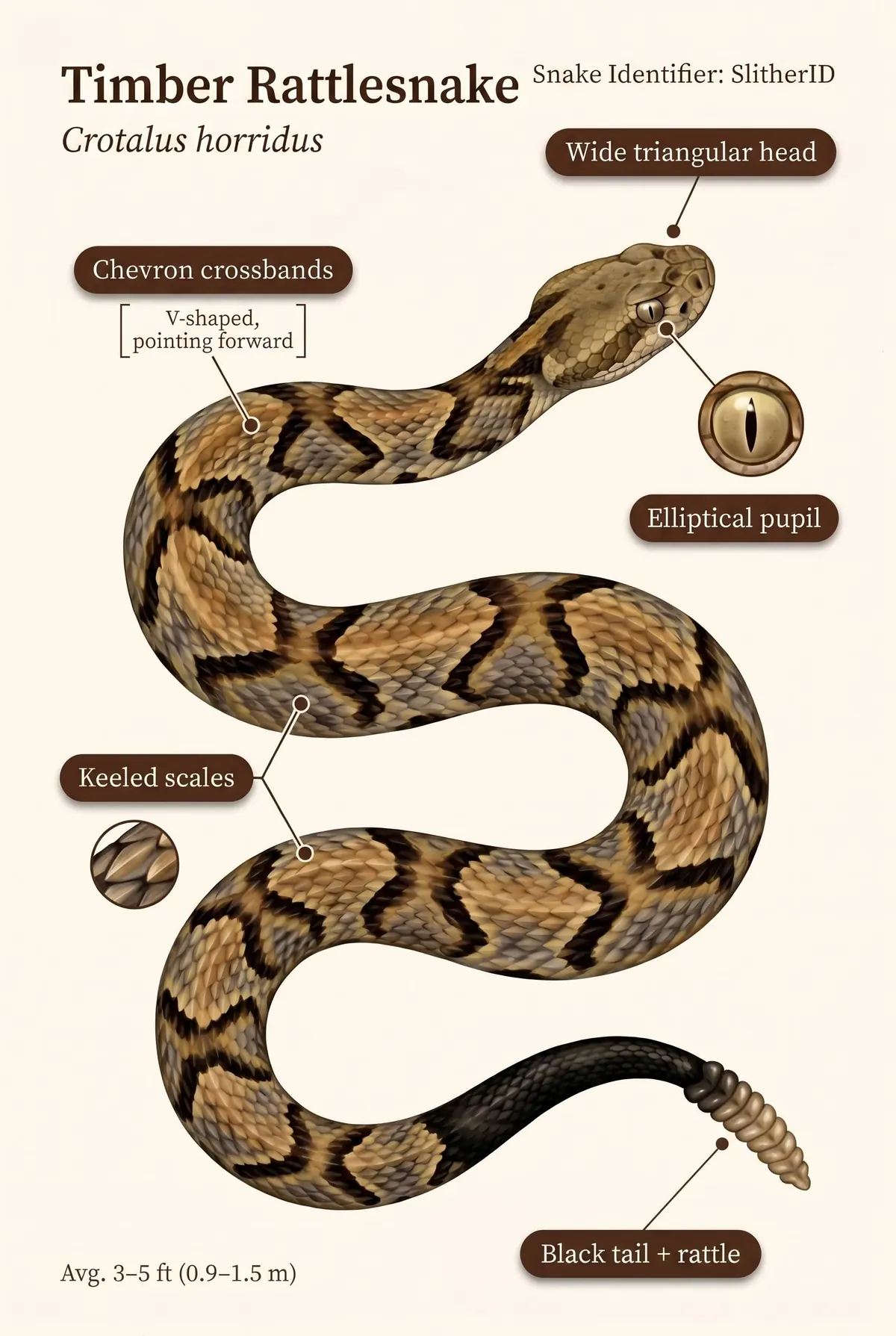
How to recognize a Timber Rattlesnake
- Dark chevron (V-shaped) crossbands pointing toward the head
- Solid black tail just before the rattle
- Wide triangular head, elliptical pupils and heat-sensing pits
- Body color varies from yellow and tan to gray or nearly black
- Usually 3 to 5 feet long
Where it lives
From New England and New York west to Minnesota and Kansas, and south to northern Florida and eastern Texas. It has disappeared from many northern areas.
States: Alabama, Arkansas, Connecticut, Florida, Georgia, Illinois, Indiana, Iowa, Kansas, Kentucky, Louisiana, Maryland, Massachusetts, Minnesota, Mississippi, Missouri, Nebraska, New Hampshire, New Jersey, New York, North Carolina, Ohio, Oklahoma, Pennsylvania, South Carolina, Tennessee, Texas, Vermont, Virginia, West Virginia, Wisconsin
Habitat
Forested hills with rocky ledges in the north; bottomland forests, canebrakes and swamps in the South. Many northern timber rattlesnakes gather at rocky dens to spend the winter.
Look-alikes and how to tell them apart
- Eastern diamondback: Diamonds instead of chevrons and a banded tail rather than a solid black one.
- Copperhead: Hourglass bands, a plain copper head and no rattle.
- Eastern rat snake: Slim body, round pupils and no rattle. Young rat snakes are gray with blotches.
Babies and young snakes
Newborns are gray or brown with dark crossbands and have only a button on the tail.
Venom and safety
Timber rattlesnakes are generally calm and often stay still, relying on camouflage. Their venom is potent and a bite needs emergency care. They are protected in many northeastern states.
Seen by SlitherID users
Recent photos of this species shared by SlitherID users in the US. Identified by AI (an estimate); each photo was reviewed by our team before it was published.
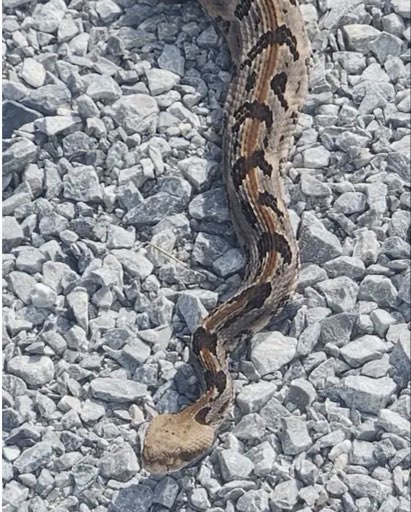 Alabama
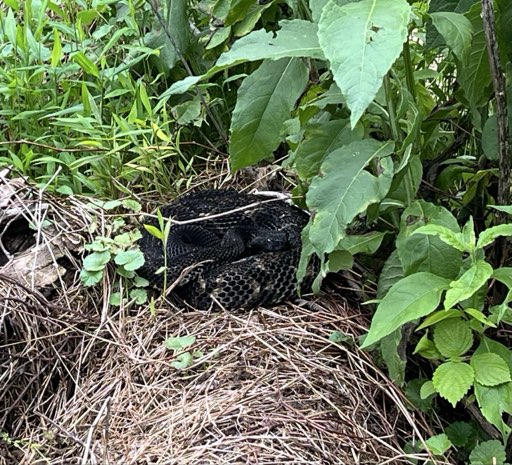 Maryland
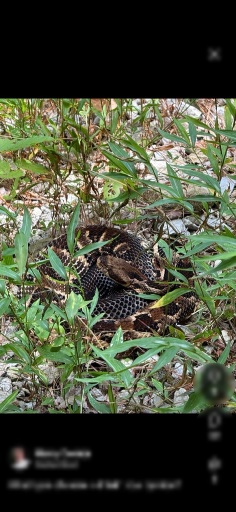 Tennessee

SlitherID identifies snakes from a photo and shows if they are venomous. For iPhone.

Questions and answers
Is a canebrake rattlesnake the same as a timber rattlesnake?
Are timber rattlesnakes protected?
Other venomous snakes
-
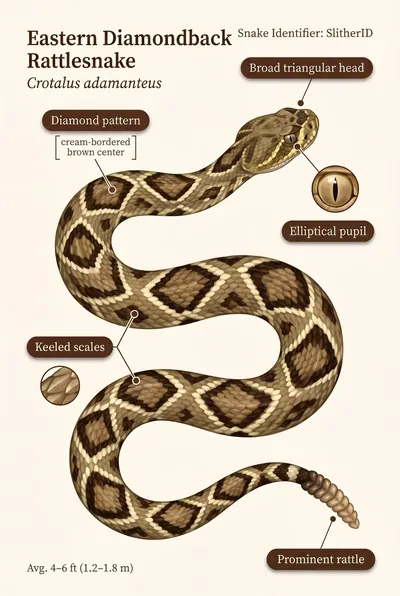 Eastern Diamondback RattlesnakeCrotalus adamanteus
-
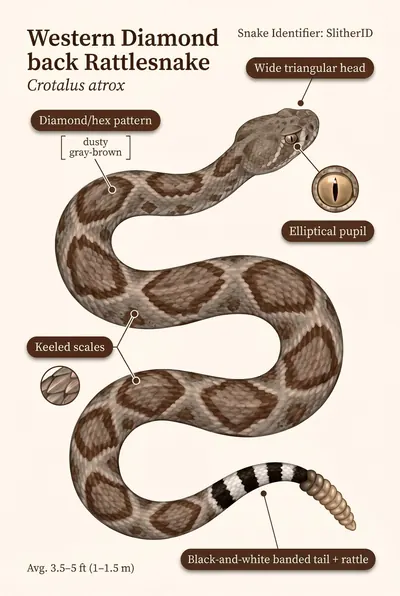 Western Diamondback RattlesnakeCrotalus atrox
-
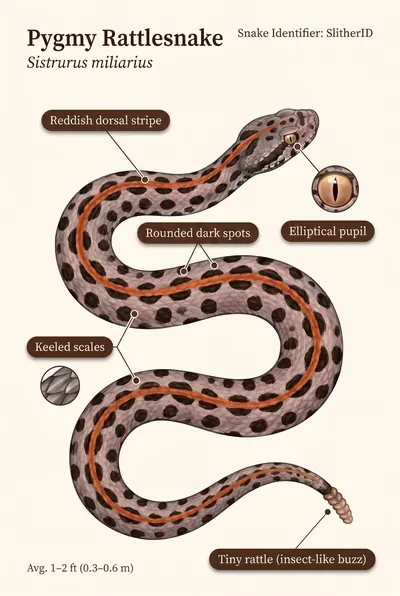 Pygmy RattlesnakeSistrurus miliarius
-
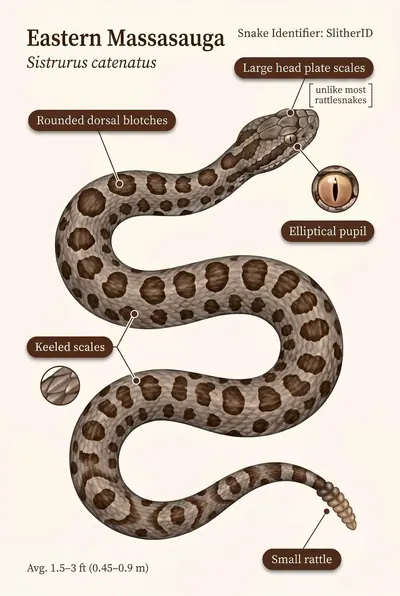 Eastern MassasaugaSistrurus catenatus
-
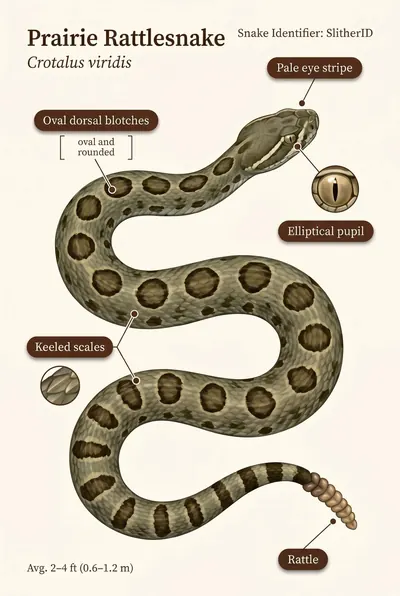 Prairie RattlesnakeCrotalus viridis
-
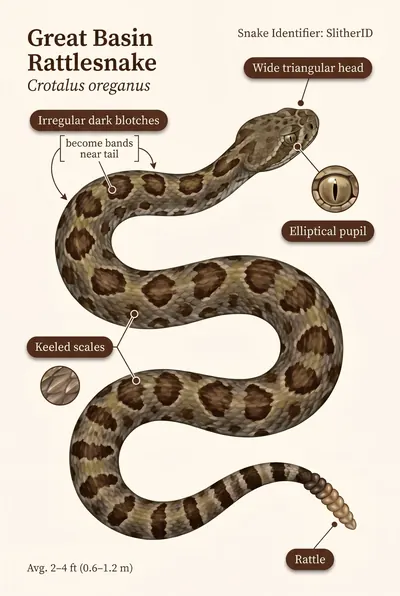 Great Basin RattlesnakeCrotalus oreganus
All 19 venomous snakes → · Venomous snake identification chart (US) →